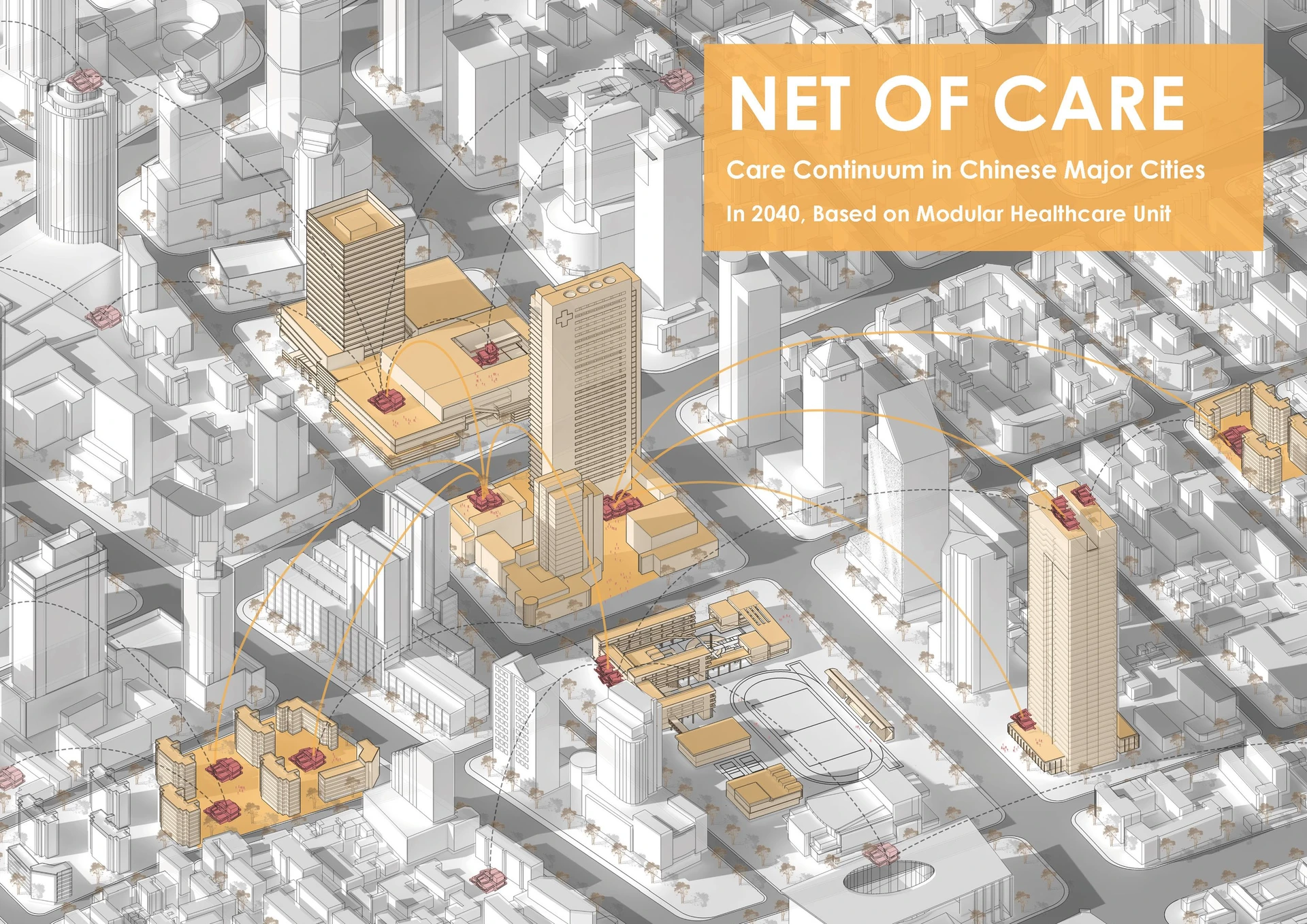
NET OF CARE: Care continuum in Chinese major cities in 2040
Client
Scale
Role
Themes
Categories
Submitted to ‘2017 UIA-PHG International Student & Young Architect Competition’
Won the award of ’Honorable Mention’ with the ranking of 7th
Background
The 2017 UIA-PHG International Student & Young Architect Competition, organized by the Public Health Group (PHG) of the International Union of Architects / Union Internationale des Architectes (UIA), was themed ‘SMART, GREEN & BEYOND: HEALTHCARE FACILITY OF THE FUTURE’. It called for ‘innovative proposals that may deal with significant future challenges: e.g., how to make use of limited resources? How to incorporate new technologies? How to meet the healthcare needs of the fast-growing aging population? How to reduce costs? In the next 15 or 30 years, how would healthcare facilities look like? How does the future design reflect the everlasting meaning of culture and tradition?’ (See the competition introduction page, and competition results page)
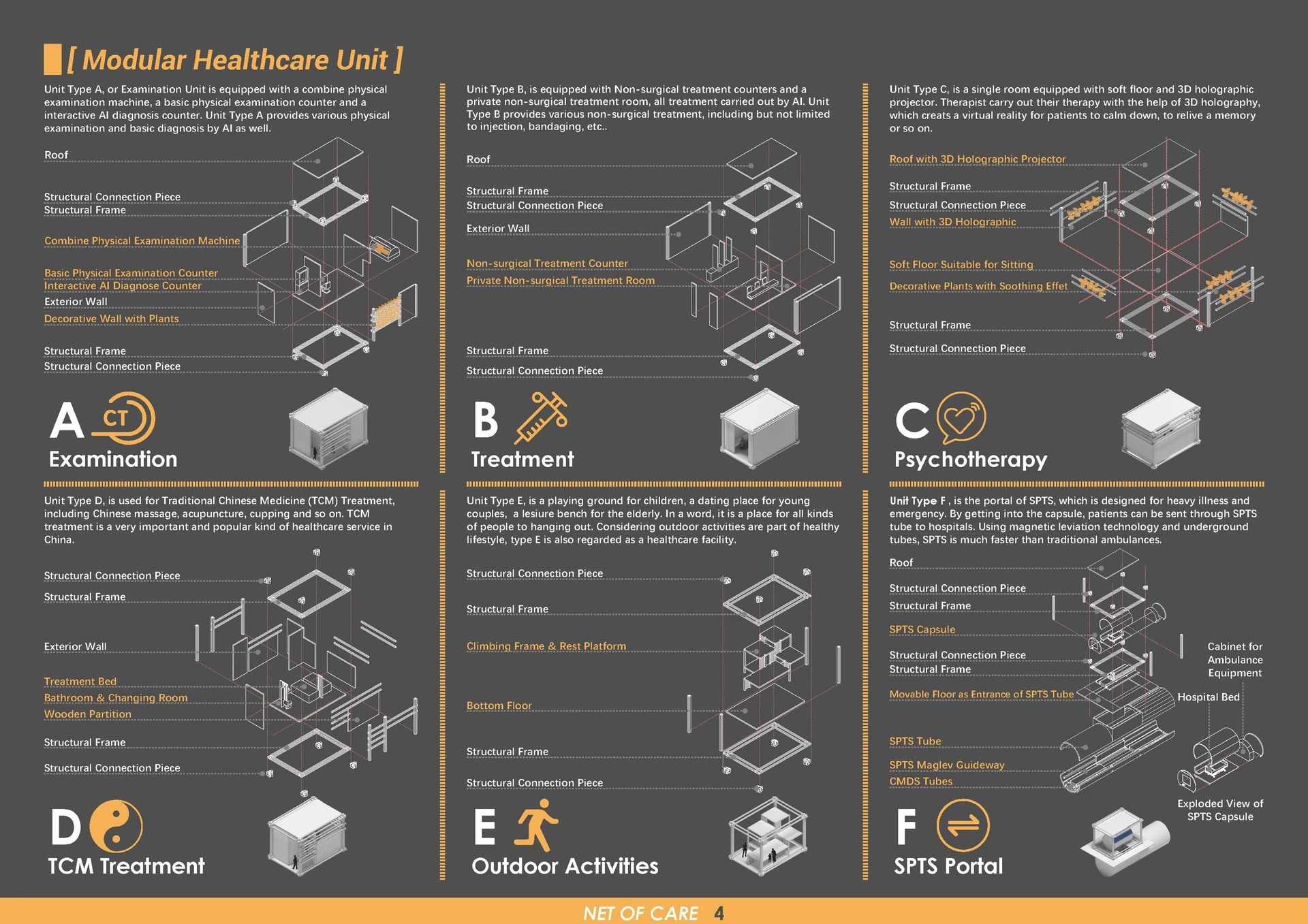
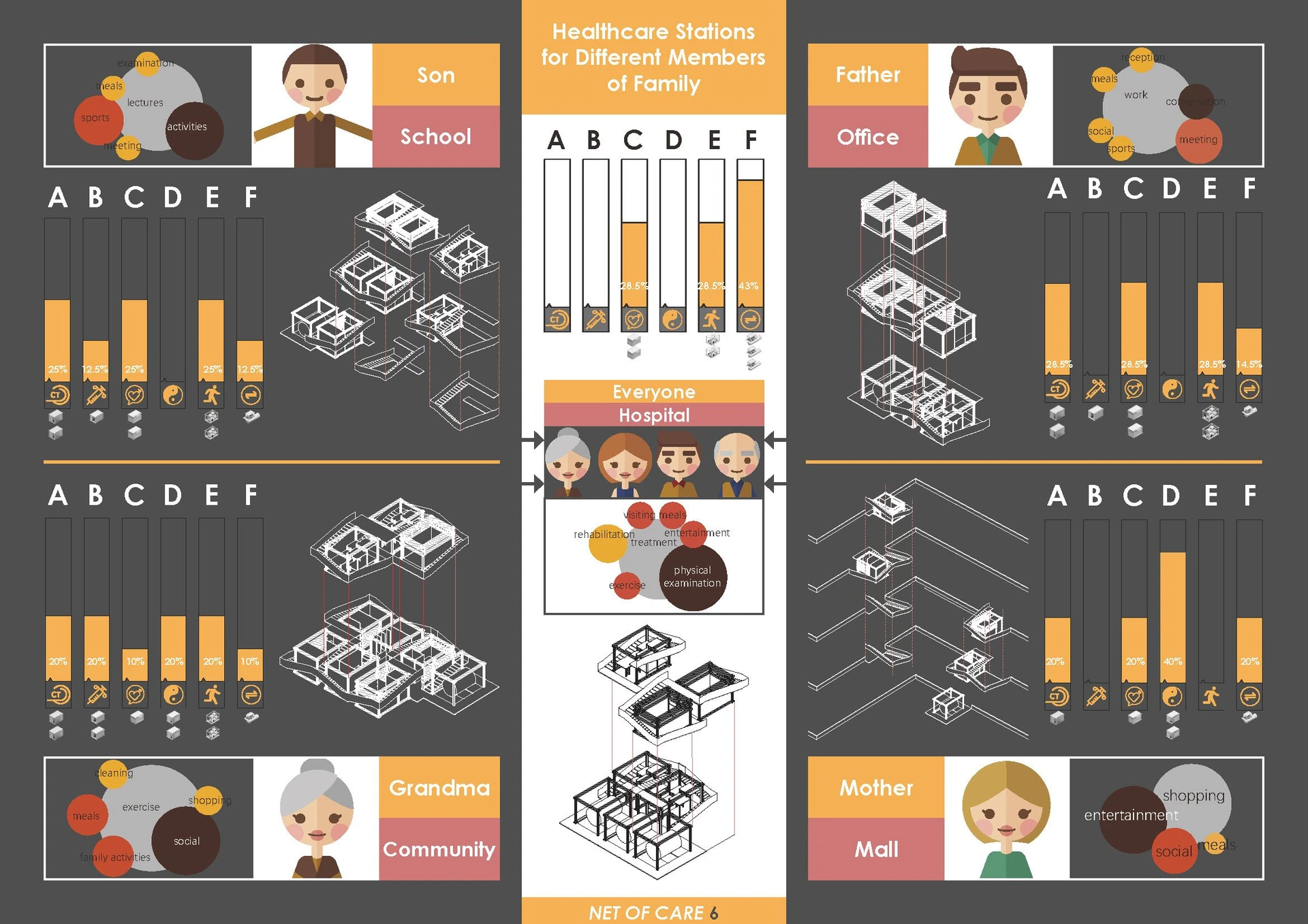
China has the largest population in the whole world, which poses a great challenge in providing adequate healthcare for its residents. In response, we propose herein a care continuum that is supposed to be established by 2040, which we named ‘NET OF CARE’, consisting of modular healthcare units, an emergency transport network and hierarchical hospitals. Modular healthcare units can be constructed into different combinations embedded into ordinary buildings to satisfy various needs, turning the city, as a whole, into a healthcare facility.
Net of Care
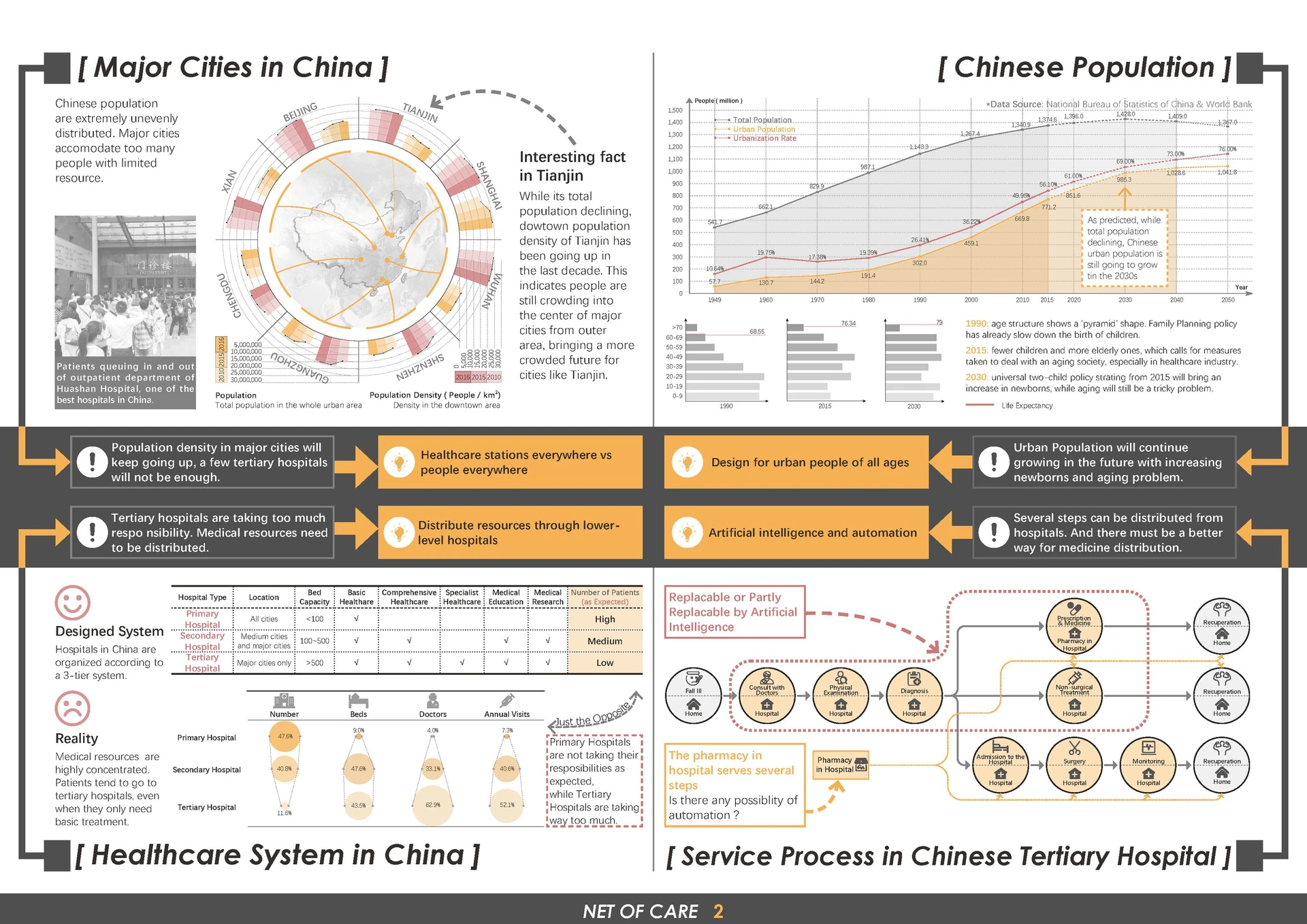
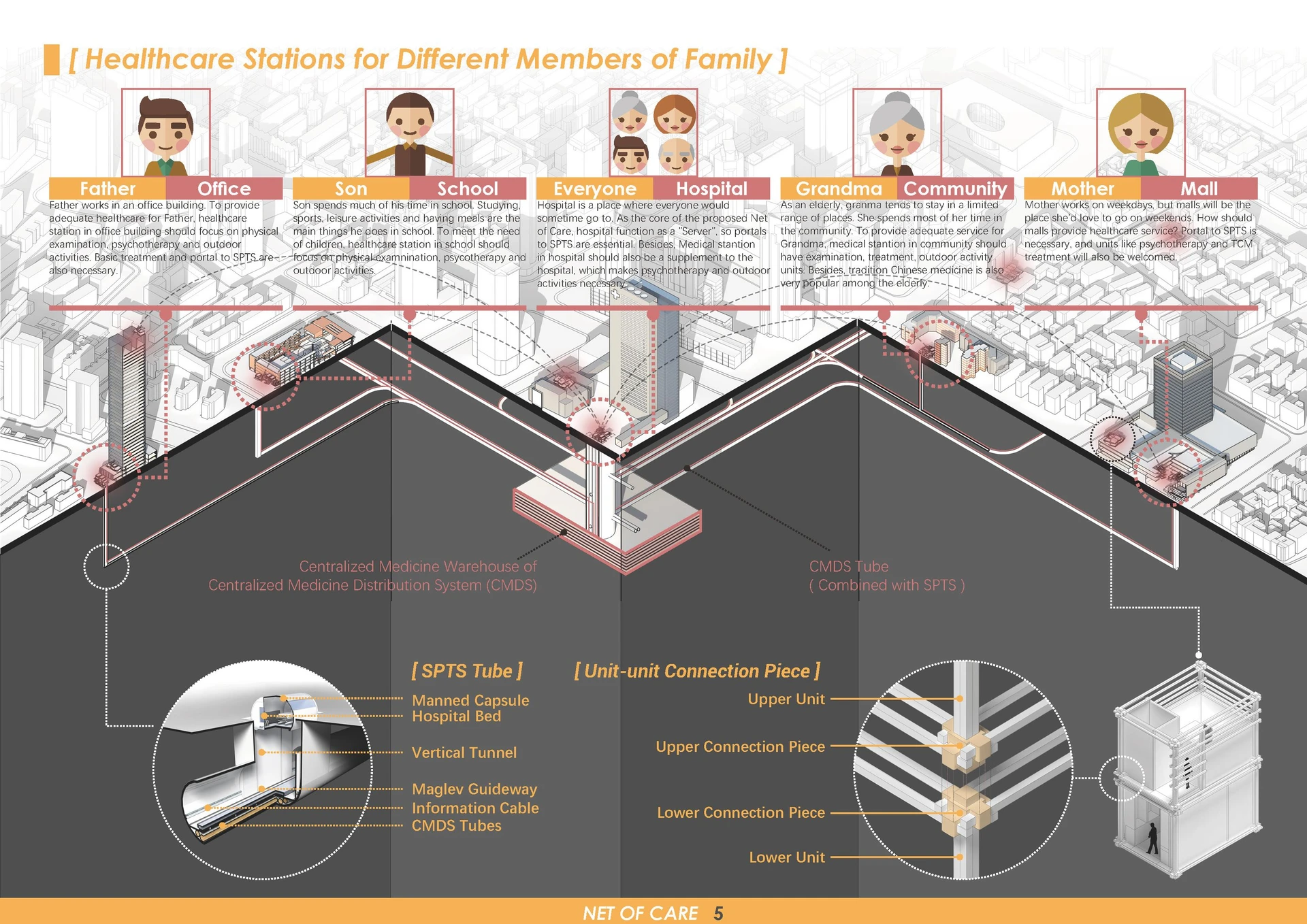
New technologies and inventions in medical science imply an opportunity to change the current service process in Chinese hospitals almost completely. Firstly, since automated pharmacies and automated medicine dispensing pipelines have already been introduced within hospitals, there is possibility to make it an city-wide infrastructure network just like electricity transmission lines and to connect each community or even each house with this network, so that citizens can get medicines on a machine near their house without having to queue in hospitals. This network can be built using existing tunnels and pipes like the subways and drain pipes, which may dramatically reduce the cost.
Secondly, AI diagnosis and automatic physical examination can make it possible to separate parts of the whole service process from the hospitals and distribute them into automatic equipment that is installed throughout the whole city. This will not completely replace real physicians and surgeons, but can function as a ‘filter’ to decide which patients need to get further check or receive surgical treatment in brick and mortar hospitals and which of them can be cured with simple prescription and basic treatment that can be done on such automatic equipment. In many parts of the world, this role of ‘filter’ is played by family doctors, a career that does not exist at all in China.
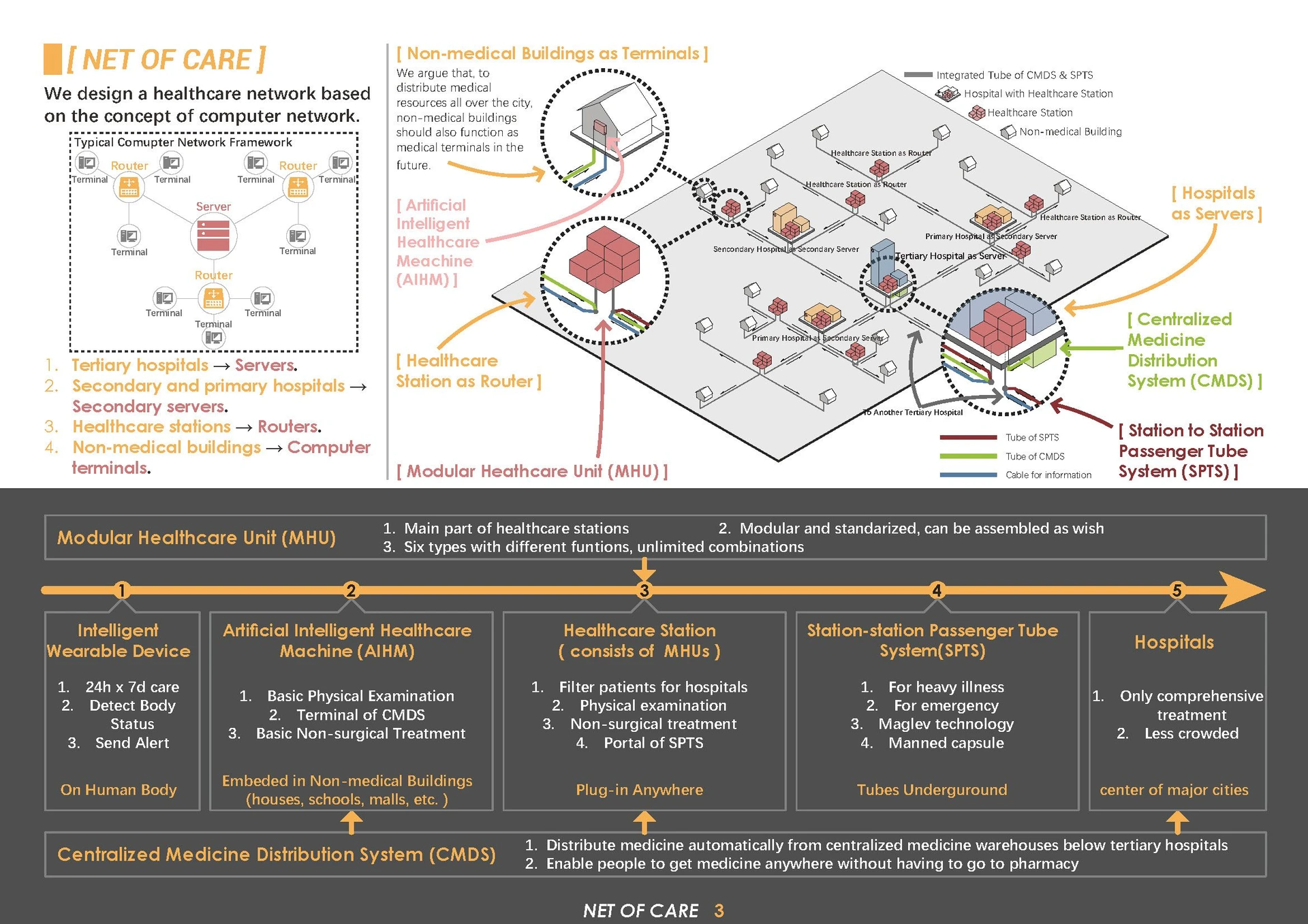
Equipment in these two systems can be built or installed together to provide comprehensive services and be connected to each other in a hierarchical manner we propose that is similar to the computer network. This hierarchical manner can be integrated into the existing healthcare system, with tertiary hospitals as ‘servers’, primary hospitals and secondary hospitals as secondary servers, newly-built healthcare stations as ‘routers’ and non-medical buildings as ‘terminals’.
In such system, by installing comprehensive equipment onto ordinary, non-medical buildings like houses, offices, schools, malls, etc., the whole city is turned into a ‘Healthcare Facility’, a ‘Care Continuum’ that we called the ‘Net of Care’. And this is what we proposed in our project in response to the theme of this competition, ‘Smart, Green & Beyond: Healthcare Facility of The Future’. We believe that this care continuum could be built or partly built by 2040 in Chinese major cities.
My role
Qian Liu, as the team leader, conceptualized the design, made analysis and prepared drawings.